ServSafe Manager: Cooking temperatures Questions
Minimum internal temperatures and hold times for meat, poultry, seafood and eggs.
41 questions in this topic. The quiz draws 20 at a time. Free, with no sign-up.
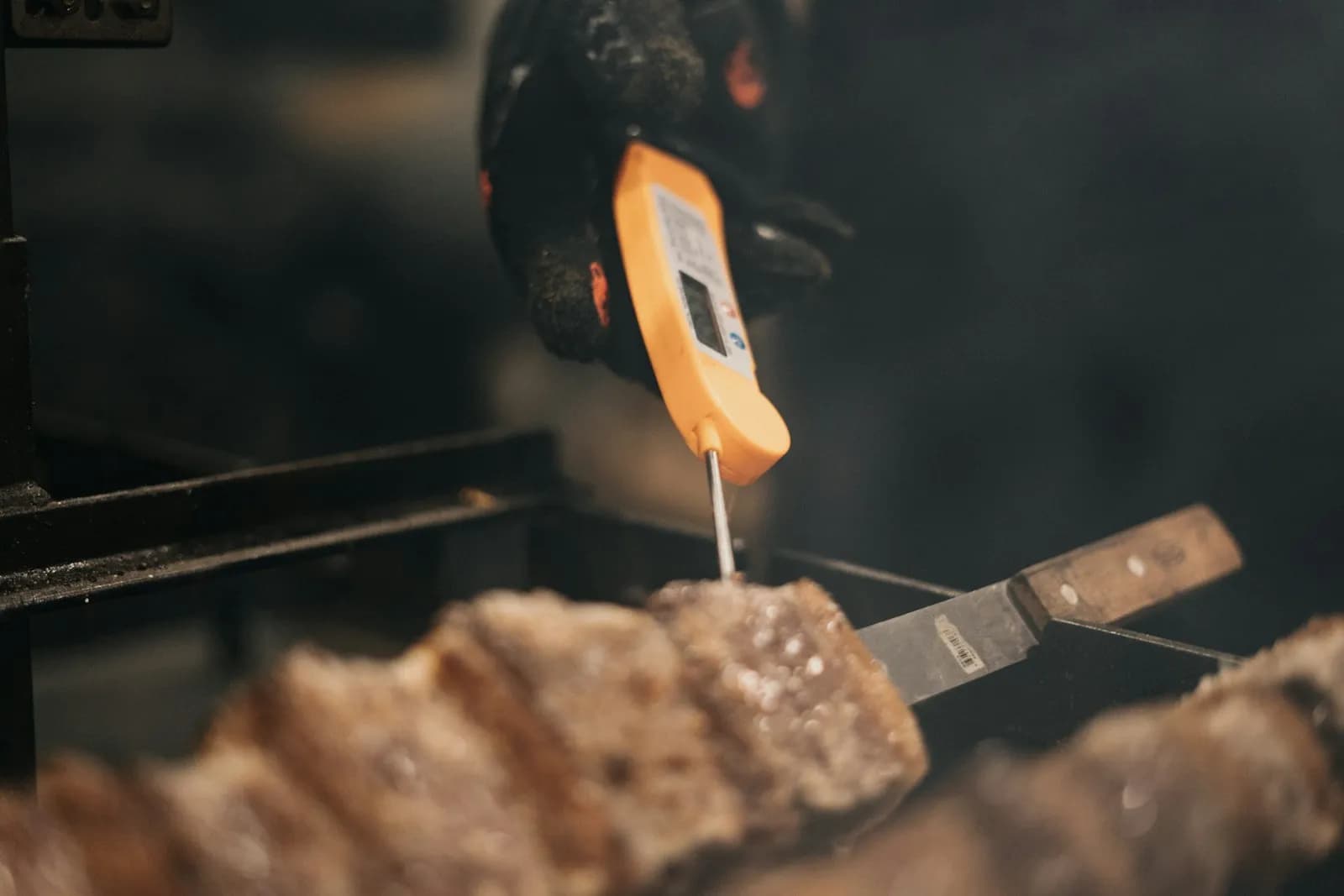
Cooking temperatures practice quiz
- 20 questions · 30 minutes · pass mark 70%
- Answers and explanations are shown at the end, with every question to review.
Key numbers
- 165°F for under 1 second: poultry and stuffed food
- 155°F for 17 seconds: ground and other non-intact meat
- 145°F for 15 seconds: fish, intact meat, and raw eggs cooked to order
- 145°F for 4 minutes: whole meat roasts
- Microwave: 165°F, then stand covered for 2 minutes
Source: FDA Food Code 2022, 3-401.11, 3-401.12, 3-501.16
What are the ServSafe temperatures?
The Food Code minimums behind ServSafe are 165°F for poultry and stuffed food, 155°F for 17 seconds for ground meat, and 145°F for 15 seconds for fish and intact meat. Hold hot food at 135°F or above.
10 sample cooking temperatures questions and answers
10 of our 41 questions, with the answer and why.
1. For shell eggs broken to order and served immediately, which ordinary minimum cooking combination applies?
Answer: 145°F (63°C) for 15 seconds
- A) 135°F (57°C) for 15 seconds
- B) 125°F (52°C) for one minute
- C) 145°F (63°C) for 15 seconds (correct answer)
- D) 100°F (38°C) until whites look opaque
Why: Eggs broken to order for immediate service use the ordinary minimum of 145°F (63°C) for 15 seconds. The 135°F (57°C) choice is below that cooking minimum.
Source: FDA Food Code 2026, 3-401.11
2. Which stuffed menu item is expressly included in the 165°F (74°C) cooking group?
Answer: Stuffed pasta
- A) An intact unstuffed fish fillet
- B) An intact unstuffed pork chop
- C) Stuffed pasta (correct answer)
- D) An ordinary unstuffed ground-beef patty
Why: Stuffed pasta is specifically listed in this cooking group. Ordinary unstuffed fish uses a different standard group.
Source: FDA Food Code 2026, 3-401.11
3. For the nonintact-meat alternative table, which hold accompanies 145°F (63°C)?
Answer: Three minutes
- A) Fifteen seconds
- B) No hold
- C) Three minutes (correct answer)
- D) Five seconds
Why: The lower-temperature alternative requires three minutes. Fifteen seconds does not meet this nonintact-meat alternative.
Source: FDA Food Code 2026, 3-401.11
4. Why is raw animal food covered during microwave cooking under the model-code procedure?
Answer: To retain surface moisture
- A) To eliminate the need to rotate or stir
- B) To permit a lower final temperature in all cases
- C) To retain surface moisture (correct answer)
- D) To replace measuring the food temperature
Why: Retaining surface moisture is the stated purpose of covering. Covering does not replace the rotation or stirring requirement.
Source: FDA Food Code 2026, 3-401.12
5. An approved noncontinuous raw-animal-food cooking process has what maximum initial heating duration?
Answer: 60 minutes
- A) Four hours
- B) Six hours
- C) 60 minutes (correct answer)
- D) An entire overnight shift
Why: The initial heating stage may not exceed sixty minutes. Four hours exceeds the initial heating limit.
Source: FDA Food Code 2026, 3-401.14
6. Partially cooked meat and cooked ready-to-eat meat look similar in a cooler. What must the approved noncontinuous procedure explain?
Answer: How to identify the partially cooked food as needing final cooking
- A) How to erase all package markings
- B) How to serve either tray without checking
- C) How to identify the partially cooked food as needing final cooking (correct answer)
- D) How to rely only on a new employee's memory
Why: The procedure must prevent partially cooked food from being mistaken for ready-to-eat food. Removing identification creates the confusion the rule addresses.
Source: FDA Food Code 2026, 3-401.14
7. For the special whole-muscle intact-beef-steak surface-cooking provision, which preparation condition must remain true?
Answer: The steak remains intact
- A) The steak has been mechanically tenderized
- B) The steak has been injected with marinade
- C) The steak remains intact (correct answer)
- D) The steak has been ground and reshaped
Why: The allowance depends on the steak retaining its intact condition. Mechanical tenderizing takes it outside the intact condition.
Source: FDA Food Code 2026, 3-401.11
8. When applying a whole-roast time-and-temperature table, which period may be included in the holding time?
Answer: Qualifying post-oven heat rise
- A) Time before the roast reaches the required temperature
- B) The time spent thawing in the cooler
- C) Qualifying post-oven heat rise (correct answer)
- D) The time waiting for the delivery truck
Why: The roast table expressly allows post-oven heat rise within holding time. Time below the applicable temperature does not satisfy its hold.
Source: FDA Food Code 2026, 3-401.11
9. A steakhouse buys beef sirloin steaks that the supplier labels as blade tenderized. They will be fully cooked, with no consumer advisory or undercooking allowance. Which minimum cooking combination applies?
Answer: 155°F (68°C) for 17 seconds
- A) 155°F (68°C) for 17 seconds (correct answer)
- B) 145°F (63°C) for 15 seconds
- C) 165°F (74°C) for less than 1 second
- D) A 145°F (63°C) top-and-bottom sear with a cooked color change
Why: Blade tenderizing is mechanical tenderization, so the steak is no longer intact meat. Nonintact meat is cooked to 155°F (68°C) for 17 seconds, not the 145°F (63°C) intact-meat combination.
Source: FDA Food Code 2022, 3-401.11(A)(2)
10. Using the whole-roast time and temperature chart, a beef roast reaches 145°F (63°C) in all parts. What minimum holding time at that temperature does the chart require?
Answer: 4 minutes
- A) 4 minutes (correct answer)
- B) 15 seconds
- C) 112 minutes
- D) 17 seconds
Why: The roast chart requires 4 minutes at 145°F (63°C), which FDA says gives the same lethality as 112 minutes at 130°F (54°C). The 15-second time is for intact steaks and chops, not whole roasts.
Source: FDA Food Code 2022, Annex 3, 3-401.11 Raw Animal Foods
Keep practicing
Once the cooking numbers stick, go back to the free ServSafe Manager practice test and try a topic you find harder.
Ready for a full paper? Try the free 90-question ServSafe practice test.
Studying for the other exam? Try the Food Handler cooking temperatures quiz.
Keeping food out of the temperature danger zone on hot and cold holding lines, and using time as a control.
41 questions in the pool, free
The two-stage cooling limits, safe cooling methods and how to reheat food for hot holding.
42 questions in the pool, free
Approved suppliers, checking deliveries, and when to reject a shipment.
42 questions in the pool, free