ServSafe Manager: Foodborne illness Questions
The germs behind foodborne illness, their symptoms, the foods they travel in and who is most at risk.
82 questions in this topic. The quiz draws 20 at a time. Free, with no sign-up.
Foodborne illness practice quiz
- 20 questions · 30 minutes · pass mark 70%
- Answers and explanations are shown at the end, with every question to review.
Key numbers
- 5 symptoms to report: vomiting, diarrhea, jaundice, sore throat with fever, an infected wound that is open or draining
- 6 illnesses to report: norovirus, hepatitis A, Shigella, Shiga toxin-producing E. coli, typhoid fever, nontyphoidal Salmonella
- Back to work after vomiting or diarrhea with no diagnosis: at least 24 hours without symptoms, or a health practitioner's note saying the cause is not infectious
- Temperature danger zone: 41°F to 135°F
Source: FDA Food Code 2022, 2-201.11, 2-201.13, Annex 3 (3-501.16)
What is time temperature abuse?
Time temperature abuse happens when time/temperature control for safety (TCS) food stays too long in the danger zone, 41°F to 135°F. Bacteria can grow and make toxins in that range.
10 sample foodborne illness questions and answers
10 of our 82 questions, with the answer and why.
1. A salad preparer receives a laboratory diagnosis of norovirus but feels well today. Who must receive this health information at the restaurant?
Answer: The person in charge
- A) The person in charge (correct answer)
- B) Only the payroll clerk
- C) Only another food worker on the same shift
- D) No one until vomiting starts
Why: A norovirus diagnosis is reportable to the person in charge even without symptoms. Payroll notification does not meet food-safety reporting duties.
Source: FDA Food Code 2026, 2-201.11
2. A new hire had diagnosed typhoid fever two months ago and received no antibiotic therapy. Which response fits the reporting rule?
Answer: Report that past illness to the person in charge
- A) Report that past illness to the person in charge (correct answer)
- B) Omit it because symptoms ended
- C) Report only illnesses from the past week
- D) Report only if the next shift includes ready-to-eat food
Why: This recent untreated typhoid history falls within the three-month reporting window. The specified past-illness duty can apply after symptoms end.
Source: FDA Food Code 2026, 2-201.11
3. Which response is NOT adequate for an employee with unexplained diarrhea?
Answer: Let the worker handle exposed food while wearing gloves
- A) Let the worker handle exposed food while wearing gloves (correct answer)
- B) Exclude the employee under the illness policy
- C) Treat the report as a food-safety issue
- D) Apply the relevant employee-health rules
Why: Gloves do not replace the required exclusion for unexplained diarrhea. Exclusion addresses the specified symptom risk.
Source: FDA Food Code 2026, 2-201.12
4. For diagnosed asymptomatic nontyphoidal Salmonella, how does the restriction rule differ between ordinary restaurants and highly susceptible settings?
Answer: Restriction applies in either setting
- A) Restriction applies in either setting (correct answer)
- B) Neither setting requires restriction
- C) Only ordinary restaurants require restriction
- D) Only highly susceptible settings require restriction
Why: The provision expressly applies restriction to both population settings. Both settings are named in the restriction requirement.
Source: FDA Food Code 2026, 2-201.12
5. A worker excluded for typhoid fever presents a practitioner letter stating freedom from infection. What other authorization is required before reinstatement?
Answer: Regulatory-authority approval
- A) Regulatory-authority approval (correct answer)
- B) Only the general manager's staffing approval
- C) Only the employee's agreement to report new symptoms
- D) Only a negative check of symptoms performed by the shift supervisor
Why: Typhoid reinstatement requires regulatory approval as well as qualifying documentation. Management's staffing decision does not replace regulatory-authority approval.
Source: FDA Food Code 2026, 2-201.13
6. A symptom-free worker has a qualifying outbreak exposure and prepares food for a highly susceptible population. Which general work control applies pending the relevant clearance?
Answer: Restrict the employee
- A) Restrict the employee (correct answer)
- B) Assume no action is needed without symptoms
- C) Wait until a laboratory test confirms an infection before imposing any restriction
- D) Let the worker self-certify immediately
Why: The highly susceptible population exposure rule specifies restriction. Qualifying exposure is separately addressed even without symptoms.
Source: FDA Food Code 2026, 2-201.12
7. The chef changes a display from whole uncut melon to fresh melon cubes without any validated non-TCS treatment. Which food-safety classification now applies to the cut fruit?
Answer: Treat the cut melon as TCS food
- A) Treat it as non-TCS solely because the whole melon was uncut earlier
- B) Classify it as non-TCS because no animal ingredient was added
- C) Treat the cut melon as TCS food (correct answer)
- D) Classify it as non-TCS whenever the serving bowl is covered
Why: Cut melons are specifically included in the TCS-food definition. The whole-fruit condition does not carry over after cutting.
Source: FDA Food Code 2022, 1-201.10
8. Which shortcut should NOT be used when deciding whether the model-code highly susceptible-population definition applies to an operation?
Answer: Assume that age alone makes every general-public restaurant a care-setting establishment
- A) Check whether the operation provides qualifying custodial or health-care services
- B) Check whether the clients include the defined vulnerable groups
- C) Assume that age alone makes every general-public restaurant a care-setting establishment (correct answer)
- D) Consider an older-adult day-care meal service under the definition
Why: The definition includes both susceptibility and the specified food-service setting. The service-setting condition is part of the definition.
Source: FDA Food Code 2022, 1-201.10
9. During a Shigella prevention review, which route from an infected food worker to a ready-to-eat meal deserves particular attention?
Answer: Fecal contamination transferred through poor hand hygiene
- A) Contamination from the worker's coughing rather than fecal transfer through poor hand hygiene
- B) Spores surviving an otherwise adequate cooking step
- C) A natural toxin already accumulated in a tropical fish
- D) Fecal contamination transferred through poor hand hygiene (correct answer)
Why: Shigella spreads primarily by the fecal-oral route and food contamination often involves an infected handler with poor hygiene. The cited primary Shigella transmission route is fecal-oral, with poor personal hygiene of an infected handler a food-contamination concern.
Source: FDA Bad Bug Book, Foodborne Pathogenic Microorganisms and Natural Toxins Handbook, Second Edition, Shigella species, Route of entry
10. A supplier confirms a tuna lot has a histamine-toxin problem. The chef proposes canning, cooking or freezing it to remove that problem. Which assessment is correct?
Answer: None of those processes reduces the toxin's toxic effects as described by FDA
- A) Cooking will resolve the toxin problem whenever the tuna reaches its ordinary cooking endpoint
- B) Freezing will remove the existing toxin even if it formed before delivery
- C) Canning resolves the toxin problem because it also controls living bacteria
- D) None of those processes reduces the toxin's toxic effects as described by FDA (correct answer)
Why: FDA states that cooking, canning and freezing do not reduce the toxic effects of scombrotoxin. The ordinary cooking endpoint does not establish destruction of this toxin.
Source: FDA Bad Bug Book, Foodborne Pathogenic Microorganisms and Natural Toxins Handbook, Second Edition, Scombrotoxin, Food Sources
Keep practicing
Germs and symptoms are only one area, so use the free ServSafe Manager practice test page to pick your next topic.
Ready for a full paper? Try the free 90-question ServSafe practice test.
Studying for the other exam? Try the Food Handler foodborne illness quiz.

Minimum internal temperatures and hold times for meat, poultry, seafood and eggs.
41 questions in the pool, free
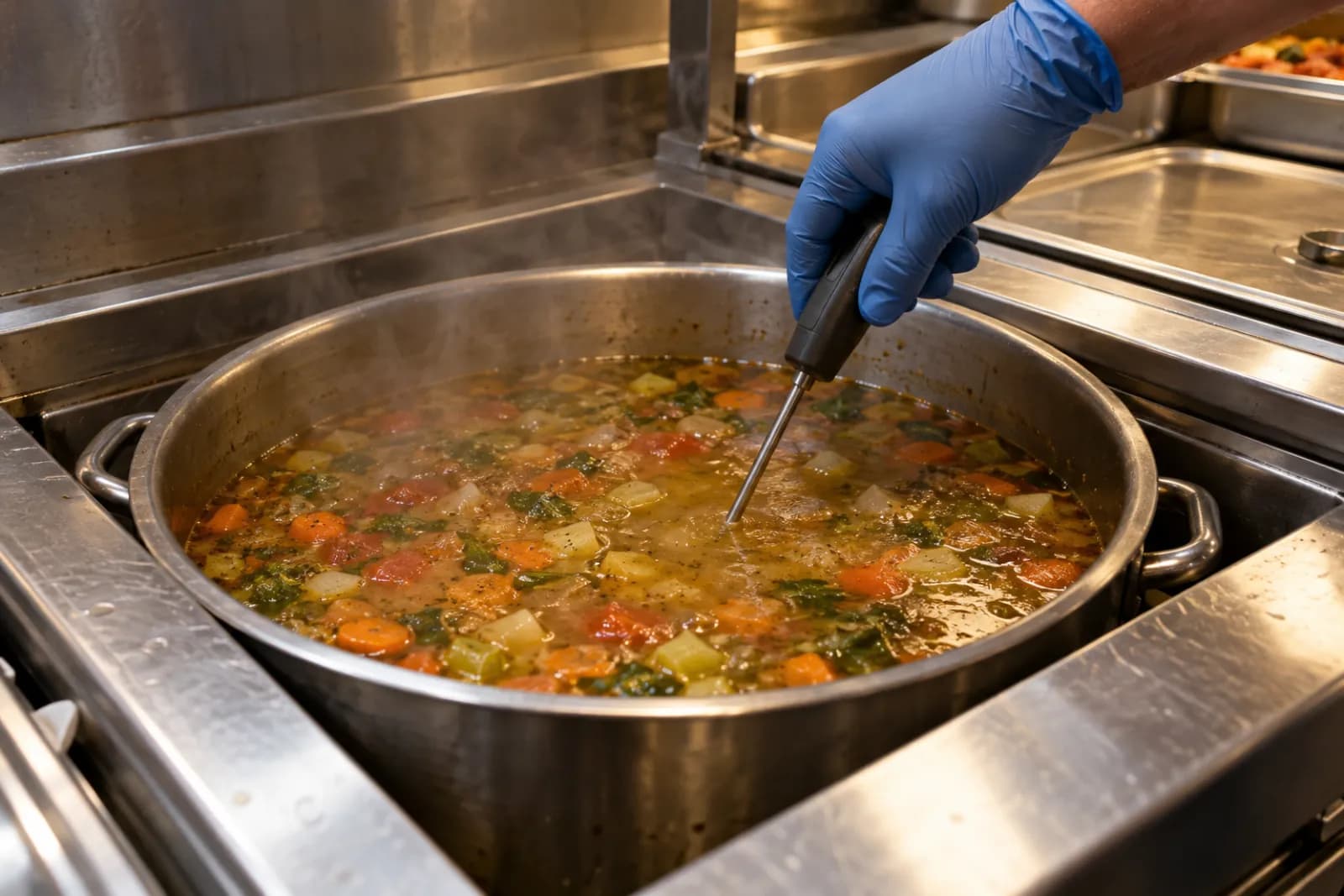
Keeping food out of the temperature danger zone on hot and cold holding lines, and using time as a control.
41 questions in the pool, free
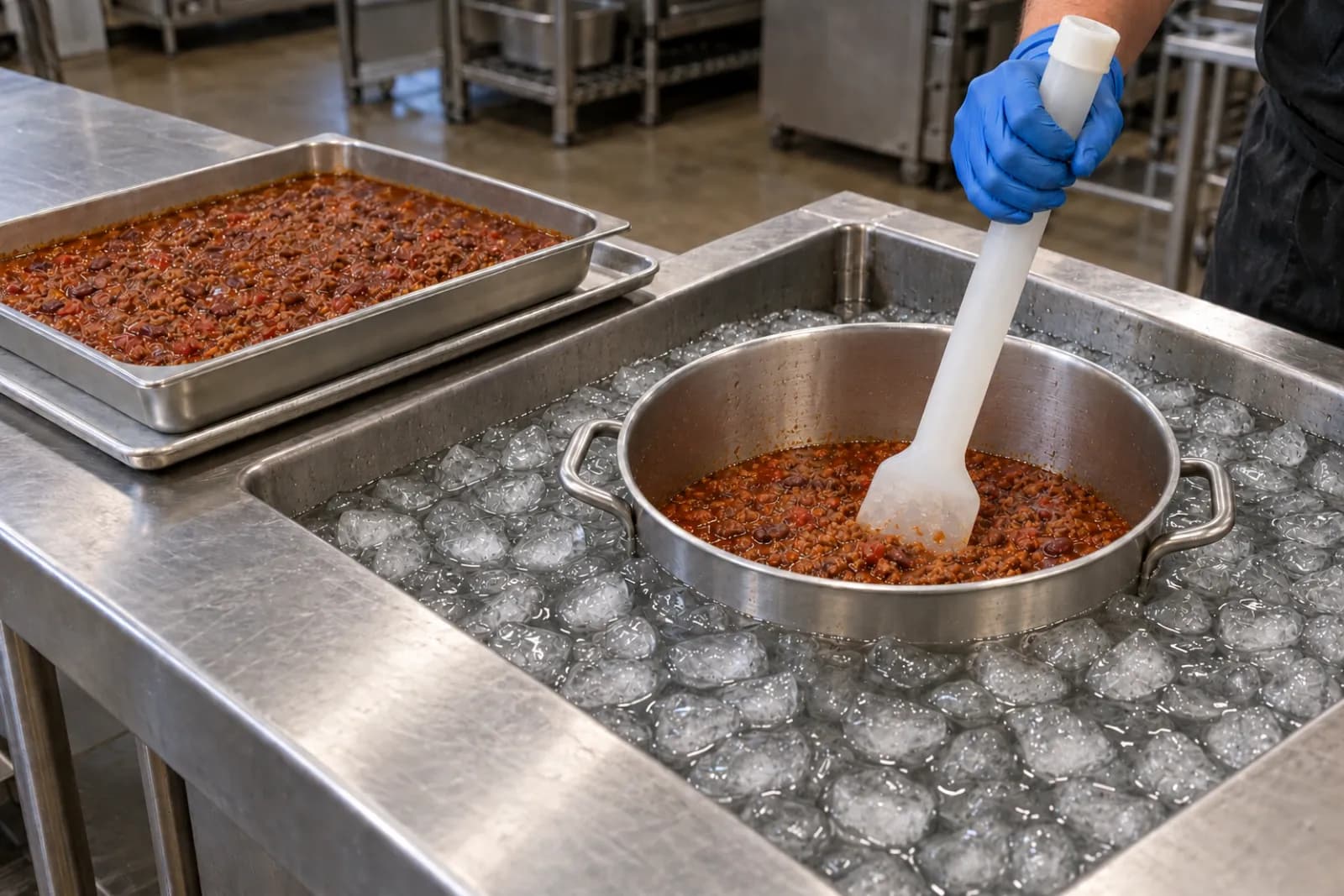
The two-stage cooling limits, safe cooling methods and how to reheat food for hot holding.
42 questions in the pool, free