ServSafe Manager: HACCP and food safety management Questions
Active managerial control, the seven HACCP principles, critical limits and corrective actions.
67 questions in this topic. The quiz draws 20 at a time. Free, with no sign-up.
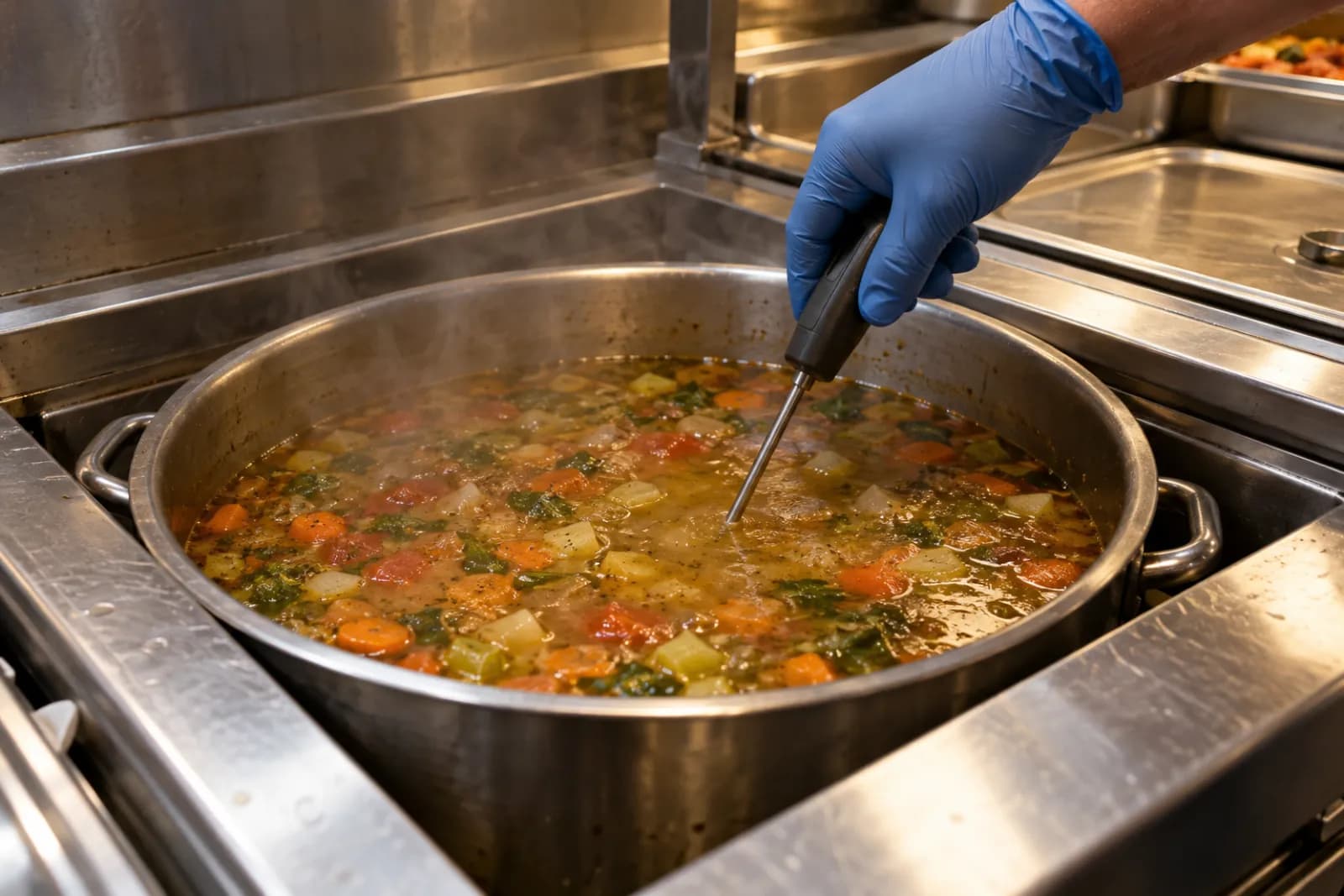
HACCP and food safety management practice quiz
- 20 questions · 30 minutes · pass mark 70%
- Answers and explanations are shown at the end, with every question to review.
Key numbers
- HACCP principles: 7
- Person in charge: keeps active managerial control of foodborne illness risk factors
- Written food safety management system: within 4 years of your regulator adopting the code
- HACCP plan: submit for approval when a variance or the law requires one
Source: FDA Food Code 2022, 8-201.13, Annex 4; November 2024 Supplement, 2-103.11, 8-201.15
What are the 7 HACCP principles?
The seven HACCP principles are hazard analysis, critical control points, critical limits, monitoring, corrective actions, verification, and record keeping.
10 sample haccp and food safety management questions and answers
10 of our 67 questions, with the answer and why.
1. An ordinary restaurant has no applicable exemption. Its designated person in charge leaves while food preparation continues. Which coverage is required?
Answer: A person in charge must remain present during operation
- A) A person in charge must remain present during operation (correct answer)
- B) Telephone availability alone always satisfies presence
- C) Only one opening visit is required
- D) The longest-serving cook fills in without anyone being designated in charge
Why: The ordinary assignment rule requires person-in-charge presence during all operating hours. Remote availability is not the ordinary presence requirement.
Source: FDA Food Code 2026, 2-101.11
2. Cooks record completion by food colour without using appropriate thermometers. What should management require in its cooking oversight?
Answer: Appropriate properly scaled and calibrated temperature devices
- A) Use the programmed oven time without checking food temperature
- B) Use the cook's judgment of browned surfaces as the sole endpoint
- C) Appropriate properly scaled and calibrated temperature devices (correct answer)
- D) Only the thermostat setting on the oven
Why: The duty specifies suitable calibrated devices for routine cooking checks. An oven program alone does not establish the required food temperatures.
Source: FDA Food Code 2026, 2-103.11
3. Under FDA 2026 duties, a worker notices suspicious handling of ingredients that could indicate intentional adulteration. Which reporting route should training emphasize?
Answer: Report suspicious activity to the person in charge
- A) Treat suspicious deliberate handling as irrelevant if food temperatures comply
- B) Report suspicious activity to the person in charge (correct answer)
- C) Wait for proof of illness before reporting the suspicious act
- D) Report only during the next scheduled staff review
Why: The food-defense duty directs employees to report suspicious activity to management. Temperature compliance does not remove the food-defense reporting duty.
Source: FDA Food Code 2026, 2-103.11
4. A required HACCP plan has limits and monitoring but no instructions for a failed limit. What element should be added before relying on the plan?
Answer: The action to take when a critical limit is not met
- A) The action to take when a critical limit is not met (correct answer)
- B) A blank corrective-action field to be interpreted during the failure
- C) An instruction to omit failed readings from the record
- D) An instruction to continue the process without evaluating the failed limit
Why: A required HACCP plan must specify the response when a critical limit is not met. A blank field does not specify the required action beforehand.
Source: FDA Food Code 2026, 8-201.14
5. An establishment subject to FDA 2026's written management-system provision keeps its system active only during inspections. What change is needed?
Answer: Implement it during all operating hours
- A) Maintain documentation without using the system during production
- B) Implement the system only while an inspector is present
- C) Implement it during all operating hours (correct answer)
- D) Use it only during annual training
Why: The provision requires implementation throughout operation. Documentation alone does not implement the system during operation.
Source: FDA Food Code 2026, 8-201.15
6. Which two hazards are expressly addressed by the reduced-oxygen-packaging controls?
Answer: Clostridium botulinum growth and toxin formation, and Listeria monocytogenes growth
- A) Only Salmonella contamination, with no consideration of anaerobic growth
- B) Clostridium botulinum growth and toxin formation, and Listeria monocytogenes growth (correct answer)
- C) Only visible mold, with no concern for pathogens in an apparently normal package
- D) Only freezing damage to the packaged product
Why: These are the organisms and effects named in the ROP provision. The ROP provision specifically identifies botulinal growth and toxin formation and Listeria growth.
Source: FDA Food Code 2026, 3-502.12
7. What label information is required under the narrow 48-hour ROP HACCP-plan exception?
Answer: Production time and date
- A) Production time and date (correct answer)
- B) Only the production date without the time
- C) Only the employee's initials without production time and date
- D) Only an undated use-first sticker
Why: The exception expressly requires both production time and production date. The exception specifies both production time and date.
Source: FDA Food Code 2026, 3-502.12
8. A facility serves a highly susceptible population. Which proposed ready-to-eat side is prohibited by the additional safeguards?
Answer: Raw seed sprouts
- A) A properly cooked and protected vegetable side
- B) A pasteurized product served under required controls
- C) Raw seed sprouts (correct answer)
- D) A properly washed permitted whole-fruit side
Why: The highly susceptible-population safeguards prohibit serving raw seed sprouts in ready-to-eat form. The properly cooked and protected vegetable choice is not the raw-sprout category prohibited here.
Source: FDA Food Code 2026, 3-801.11
9. A restaurant uses the particular no-variance cook-chill or sous-vide route that limits preparation and consumption to its business entity. Which proposed distribution falls outside that condition?
Answer: Selling the sealed packaged product to a separate business
- A) Preparing and consuming it at the same restaurant under all required controls
- B) Using a compliant satellite of the same business with required transport controls
- C) Selling the sealed packaged product to a separate business (correct answer)
- D) Keeping the packaged product within the same business before compliant service
Why: The route does not permit distribution or sale of that packaged product to another business entity. Same-premises preparation and consumption can meet the entity condition.
Source: FDA Food Code 2022, 3-502.12
10. A hospital uses the specific HACCP exception for combining raw eggs. Its plan specifies adequate cooking but says nothing about Salmonella Enteritidis growth before or after cooking. Which safeguard is missing?
Answer: Practices controlling growth both before and after cooking
- A) A statement that the cooking step makes pre-cook and post-cook growth controls unnecessary
- B) An optional customer advisory instead of controls over egg handling
- C) Practices controlling growth both before and after cooking (correct answer)
- D) Only a second cooking-temperature check, without controls before or after cooking
Why: This exception requires controlling Salmonella Enteritidis growth before and after cooking, in addition to destroying it through the specified cooking. A cooking endpoint alone leaves those separate growth controls unaddressed.
Source: FDA Food Code 2022, 3-801.11
Keep practicing
HACCP touches many other topics, so work through the rest of the ServSafe Manager exam questions after this one.
Ready for a full paper? Try the free 90-question ServSafe practice test.
Cleaning versus sanitizing, sanitizer strength, dishwashing and three-compartment sinks.
90 questions in the pool, free
Handwashing sinks, plumbing, backflow, ventilation, lighting and approved equipment.
68 questions in the pool, free
Keeping pests out, signs of an infestation, and working with a licensed operator.
27 questions in the pool, free